Enhancing Soil Health through Conservation Agriculture
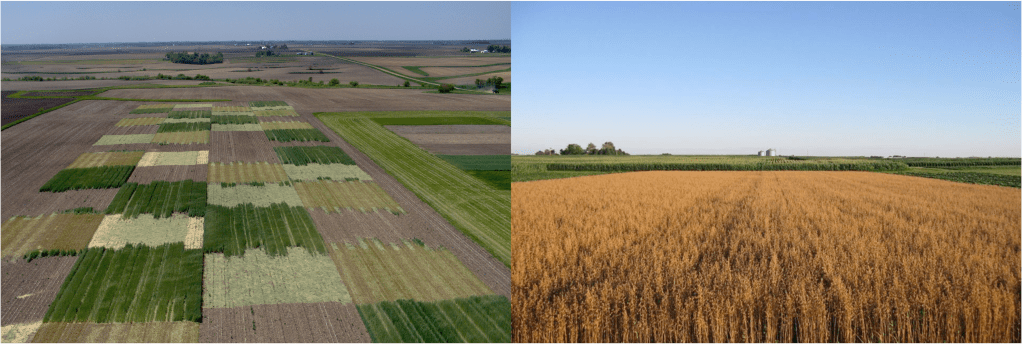
Promoting soil organic matter (SOM) accumulation in croplands is a central goal of agricultural sustainability. However, gains in SOM under conservation agriculture remain elusive and highly context dependent. To address this challenge, we integrate field measurements, lab incubations and process-based modeling to investigate SOM dynamics and the key biogeochemical controls in conservation agricultural practices, such as cover crops and diversified cropping systems. Our goal is to improve the quantification and prediction of SOM storage and related soil health metrics following conversation agricultural practices. Ultimately, this work aims to inform agricultural management, policy development, and market-based sustainability incentives.
Some results have been published in Yi, Huang et al., Nature Sustainability, 2025; Huang et al., Global Change Biology, 2025.
Resolving Mechanisms Controlling Soil Organic Carbon (SOC) Formation and Persistence
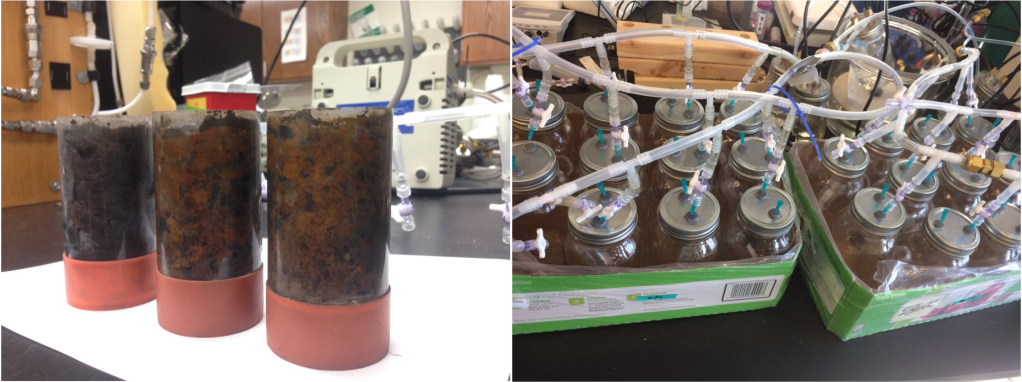
A comprehensive understanding of the mechanisms responsible for SOC formation and persistence is critical for predicting carbon cycling and sustaining food production and broader ecosystem services. Through field measurements, lab incubation and microbial models, we reveal under-appreciated geochemical processes controlling C stabilization and emission (as CO2 and CH4) in both natural and agricultural soils. We aim to inform theory and mechanistic model development and provide implications for guiding effective ecosystem conservation practices and promoting long-term ecosystem sustainability.
Some results have been published in Huang et al., Global Change Biology, 2020 and 2021; Huang and Hall, Nature Communications, 2017.
Improving Water Quality through Edge-of-Field Conservation Practices
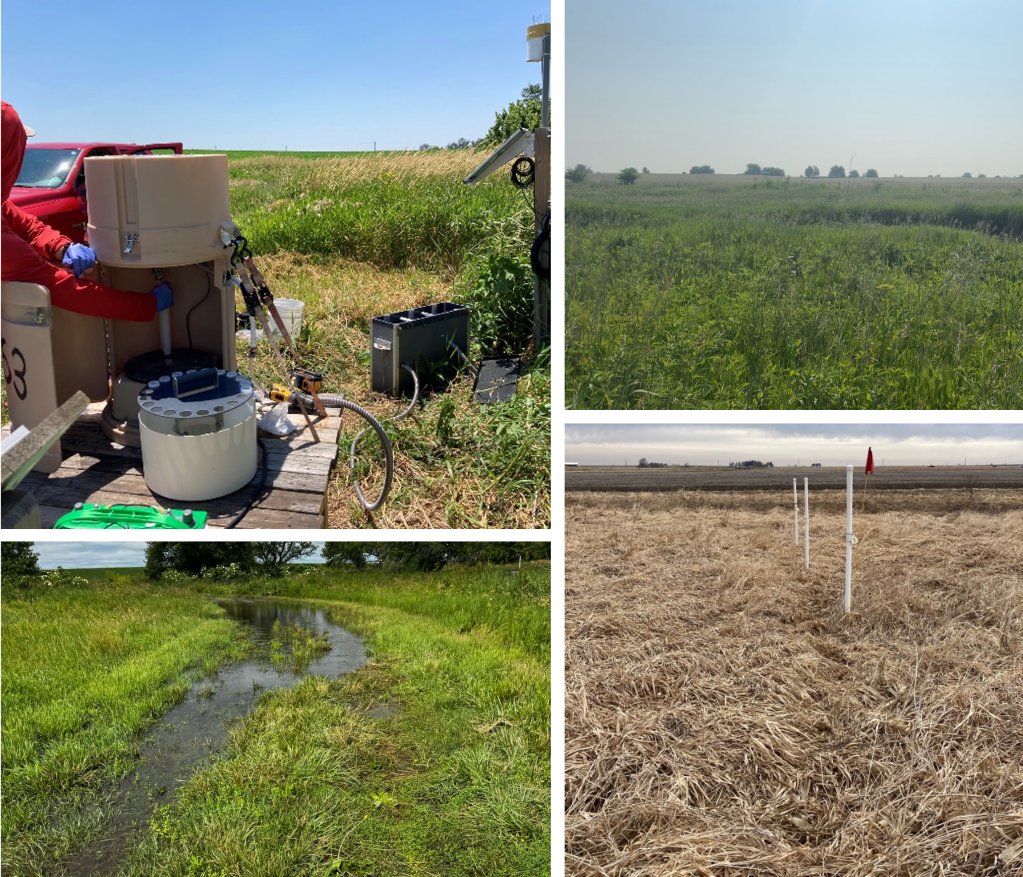
Agricultural nutrient losses, particularly nitrate and phosphorus, are major contributors to water quality degradation in rivers, lakes, and downstream ecosystems. Our research examines innovative conservation practices that reduce nutrient losses from agricultural landscapes while maintaining productive cropping systems. One focus of our work is saturated riparian buffers (SRBs), an edge-of-field conservation practice that diverts tile drainage water into riparian buffer soils, where microbial processes can remove nitrate through denitrification. We integrate long-term field monitoring, lab incubation, and machine learning to understand how SRBs can effectively and simultaneously reduce nitrate and phosphorus losses. This research seeks to advance science-based strategies for improving agricultural water quality, supporting nutrient reduction goals, and guiding the design and implementation of effective conservation practices across agricultural landscapes.
 Soil Biogeochemistry Lab